> ## Documentation Index
> Fetch the complete documentation index at: https://docs.0mcp.io/llms.txt
> Use this file to discover all available pages before exploring further.
# What is MCP?
> Learn what the Model Context Protocol (MCP) is, what the name means, and how it connects AI applications to external data, tools, and workflows.
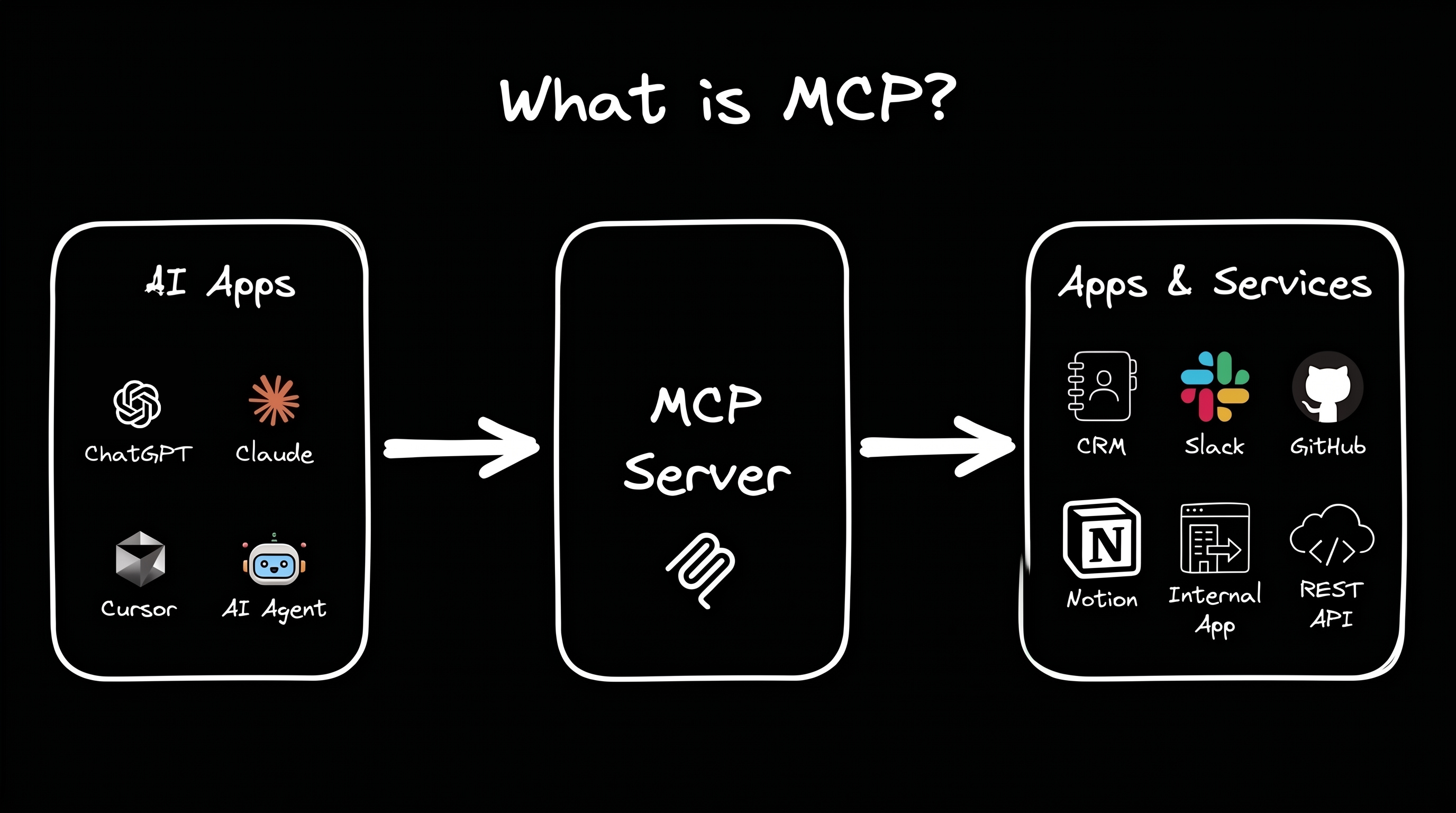
The **[Model Context Protocol](https://modelcontextprotocol.io/) (MCP)** is an open standard for connecting AI applications to external systems.
It gives AI applications a consistent way to access data, use [tools](/learn/core-concepts/tools), and work with reusable instructions. These external capabilities can come from APIs, databases, files, SaaS products, developer tools, or internal business systems.
In plain English, MCP is a shared connection language for AI applications.
```text theme={null}
AI application <-> MCP <-> External system
```
You can think of MCP as a universal connector. The same type of connection can work across different AI applications and external services, as long as both support the protocol.
 ## What does MCP stand for?
MCP stands for **Model Context Protocol**:
* **Model** refers to the AI model or AI-powered application that needs outside information or capabilities.
* **Context** means the data, tools, and instructions that help the AI understand a request and respond usefully.
* **Protocol** is an agreed set of rules that lets different software systems communicate.
Together, these words describe a standard way to give AI applications access to useful context beyond what the model already knows.
## What does MCP connect?
MCP connects an AI application to an external system through an MCP-compatible interface.
The AI application might be:
* An AI assistant
* A coding assistant
* An autonomous agent
* An internal company chatbot
* An AI feature inside a SaaS product
The external system might be:
* An API
* A database
* A file system
* A source code repository
* A CRM or support platform
* A search service
* An internal business application
MCP does not turn these systems into AI models. It makes their approved information and capabilities available to AI applications in a standard format.
## What can an MCP server provide?
An MCP server can expose three common types of capabilities:
| Capability | What it provides | Simple example |
| ------------- | ------------------------------------------ | -------------------------- |
| **Tools** | Actions an AI application can request | Create a support ticket |
| **Resources** | Data or content an AI application can read | Retrieve a product policy |
| **Prompts** | Reusable instruction templates | Prepare a customer summary |
These capabilities describe what an external system makes available through MCP. The system owner controls which data and actions the server exposes.
## A simple MCP example
Imagine an AI assistant that needs current order information.
The order data lives in an e-commerce API, not inside the AI model. An MCP server can expose an approved capability for retrieving an order. The assistant can then use that capability when a user asks:
> Where is order 1042?
The AI assistant still handles the conversation. The external system remains the source of the order data. MCP provides the standard connection between them.
## Is MCP the same as an API?
No. MCP and APIs are related, but they are not the same.
An API defines how software interacts with a particular service. MCP defines a standard interface that AI applications can use to discover and access external capabilities.
An MCP server often sits in front of an existing API:
```text theme={null}
AI application <-> MCP server <-> API
```
The API continues to handle the underlying business data and operations. The MCP server presents selected capabilities in a format designed for MCP-compatible AI applications.
## What MCP is not
MCP is not:
* An AI model
* A replacement for an API
* A database or knowledge base
* A guarantee that an AI application can access every connected system
* A permission to bypass authentication or security controls
MCP is the communication standard between compatible AI applications and external capabilities. Access still depends on the server configuration, authentication, permissions, and user approval.
## MCP in one sentence
**MCP is an open standard that lets AI applications connect to external data, tools, and workflows through a consistent interface.**
## What does MCP stand for?
MCP stands for **Model Context Protocol**:
* **Model** refers to the AI model or AI-powered application that needs outside information or capabilities.
* **Context** means the data, tools, and instructions that help the AI understand a request and respond usefully.
* **Protocol** is an agreed set of rules that lets different software systems communicate.
Together, these words describe a standard way to give AI applications access to useful context beyond what the model already knows.
## What does MCP connect?
MCP connects an AI application to an external system through an MCP-compatible interface.
The AI application might be:
* An AI assistant
* A coding assistant
* An autonomous agent
* An internal company chatbot
* An AI feature inside a SaaS product
The external system might be:
* An API
* A database
* A file system
* A source code repository
* A CRM or support platform
* A search service
* An internal business application
MCP does not turn these systems into AI models. It makes their approved information and capabilities available to AI applications in a standard format.
## What can an MCP server provide?
An MCP server can expose three common types of capabilities:
| Capability | What it provides | Simple example |
| ------------- | ------------------------------------------ | -------------------------- |
| **Tools** | Actions an AI application can request | Create a support ticket |
| **Resources** | Data or content an AI application can read | Retrieve a product policy |
| **Prompts** | Reusable instruction templates | Prepare a customer summary |
These capabilities describe what an external system makes available through MCP. The system owner controls which data and actions the server exposes.
## A simple MCP example
Imagine an AI assistant that needs current order information.
The order data lives in an e-commerce API, not inside the AI model. An MCP server can expose an approved capability for retrieving an order. The assistant can then use that capability when a user asks:
> Where is order 1042?
The AI assistant still handles the conversation. The external system remains the source of the order data. MCP provides the standard connection between them.
## Is MCP the same as an API?
No. MCP and APIs are related, but they are not the same.
An API defines how software interacts with a particular service. MCP defines a standard interface that AI applications can use to discover and access external capabilities.
An MCP server often sits in front of an existing API:
```text theme={null}
AI application <-> MCP server <-> API
```
The API continues to handle the underlying business data and operations. The MCP server presents selected capabilities in a format designed for MCP-compatible AI applications.
## What MCP is not
MCP is not:
* An AI model
* A replacement for an API
* A database or knowledge base
* A guarantee that an AI application can access every connected system
* A permission to bypass authentication or security controls
MCP is the communication standard between compatible AI applications and external capabilities. Access still depends on the server configuration, authentication, permissions, and user approval.
## MCP in one sentence
**MCP is an open standard that lets AI applications connect to external data, tools, and workflows through a consistent interface.**