

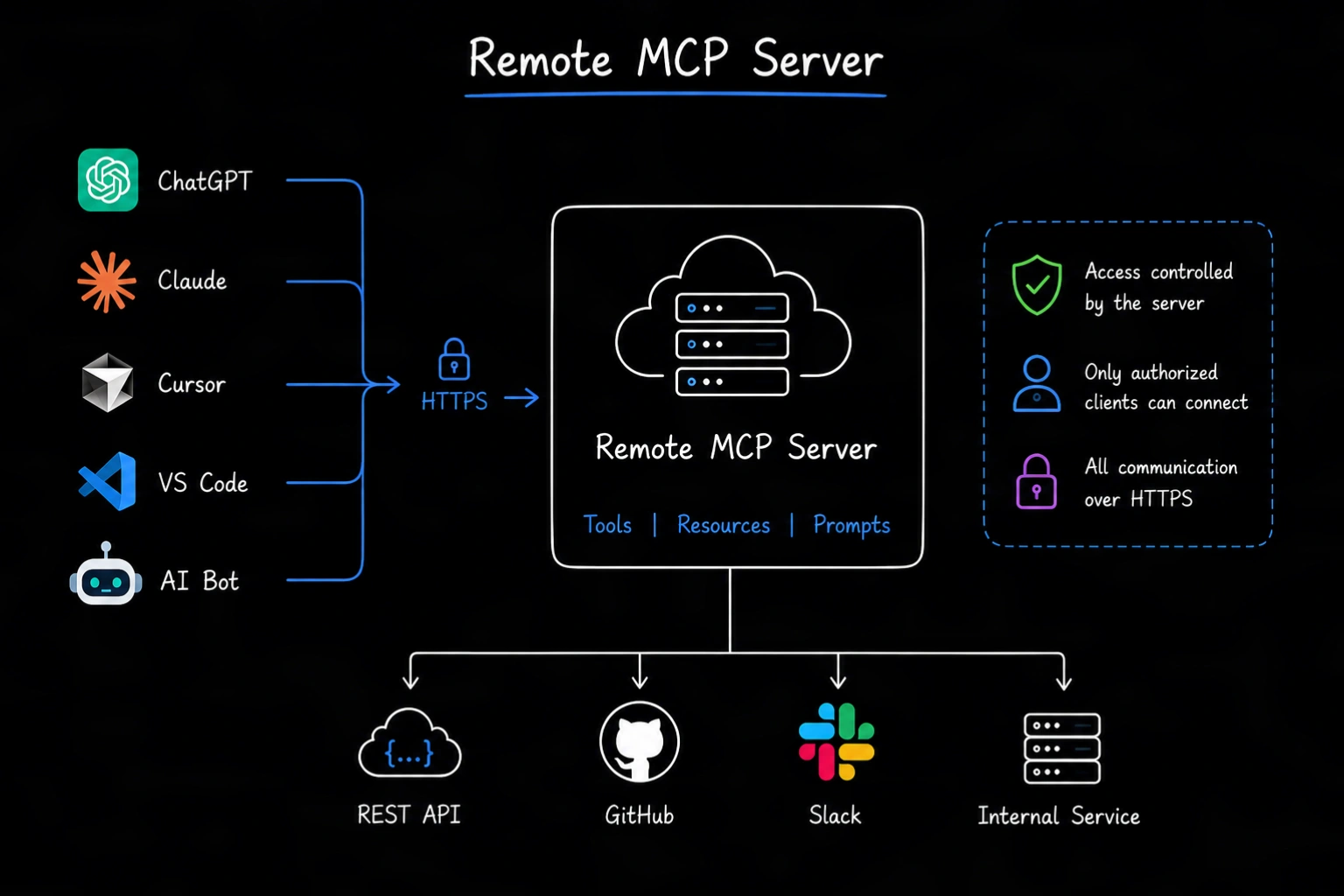
What makes an MCP server remote?
The server runs outside the client environment and remains available independently of one user’s computer. It may run on:- A virtual machine
- A container platform
- Kubernetes
- A serverless platform
- An edge runtime
- A managed MCP hosting service
How remote MCP connections work
Modern remote MCP servers commonly use Streamable HTTP. The client sends MCP messages through HTTP requests. The server may return a complete response or stream supported messages. The server can maintain an MCP session when its implementation requires one. Remote deployment does not change the core protocol concepts. Clients still initialize, negotiate capabilities, discover features, and send JSON-RPC requests. Read How MCP works for the full session sequence.When to use a remote MCP server
Choose a remote server when:- Several users or applications need the same capabilities
- The underlying system is already an internet-accessible API
- You need centralized updates and configuration
- You need production monitoring and availability
- The workload requires scalable infrastructure
- A SaaS product wants to publish an MCP endpoint
Benefits of remote MCP servers
Shared access
One deployment can serve multiple authorized users and clients.Centralized maintenance
You can update tools, fix bugs, rotate credentials, and apply policies in one place.Production operations
Hosted infrastructure can support logging, metrics, alerts, rate limits, load balancing, and regional deployment.API proximity
A remote MCP server can run near its upstream API or data services, reducing internal network hops and keeping service credentials on controlled infrastructure.Remote server responsibilities
A production remote server needs more than protocol support. Plan for:- HTTPS
- Authentication and authorization
- Secure token handling
- Tenant isolation
- Input validation
- Rate limiting
- Request timeouts
- Structured logs and metrics
- Health checks
- Version management
- Safe error responses
Authentication and authorization
A remote server must identify callers and decide which capabilities they may use. Use the authentication model supported by your clients and deployment. OAuth-based authorization is common for user-facing remote servers. Service-to-service environments may use scoped tokens or other established credentials. The server should apply least privilege. A user who can read orders should not automatically receive access to refund tools. If your MCP server wraps an API, the upstream API should continue enforcing its own authorization rules. Review the 0mcp authentication model for API-backed servers.Stateless and stateful deployment
Some MCP interactions use session state. If you run more than one server replica, decide where that state lives. Common approaches include:- Keep state in a shared store
- Route a session consistently to one replica
- Design operations to minimize server-side session state
Scaling a remote MCP server
AI applications may call tools in bursts or chains. Protect the server and upstream systems with:- Concurrency limits
- Per-user and per-tool rate limits
- Bounded response sizes
- Pagination
- Caching for safe read operations
- Queues for long-running work
- Idempotency for retryable write operations