

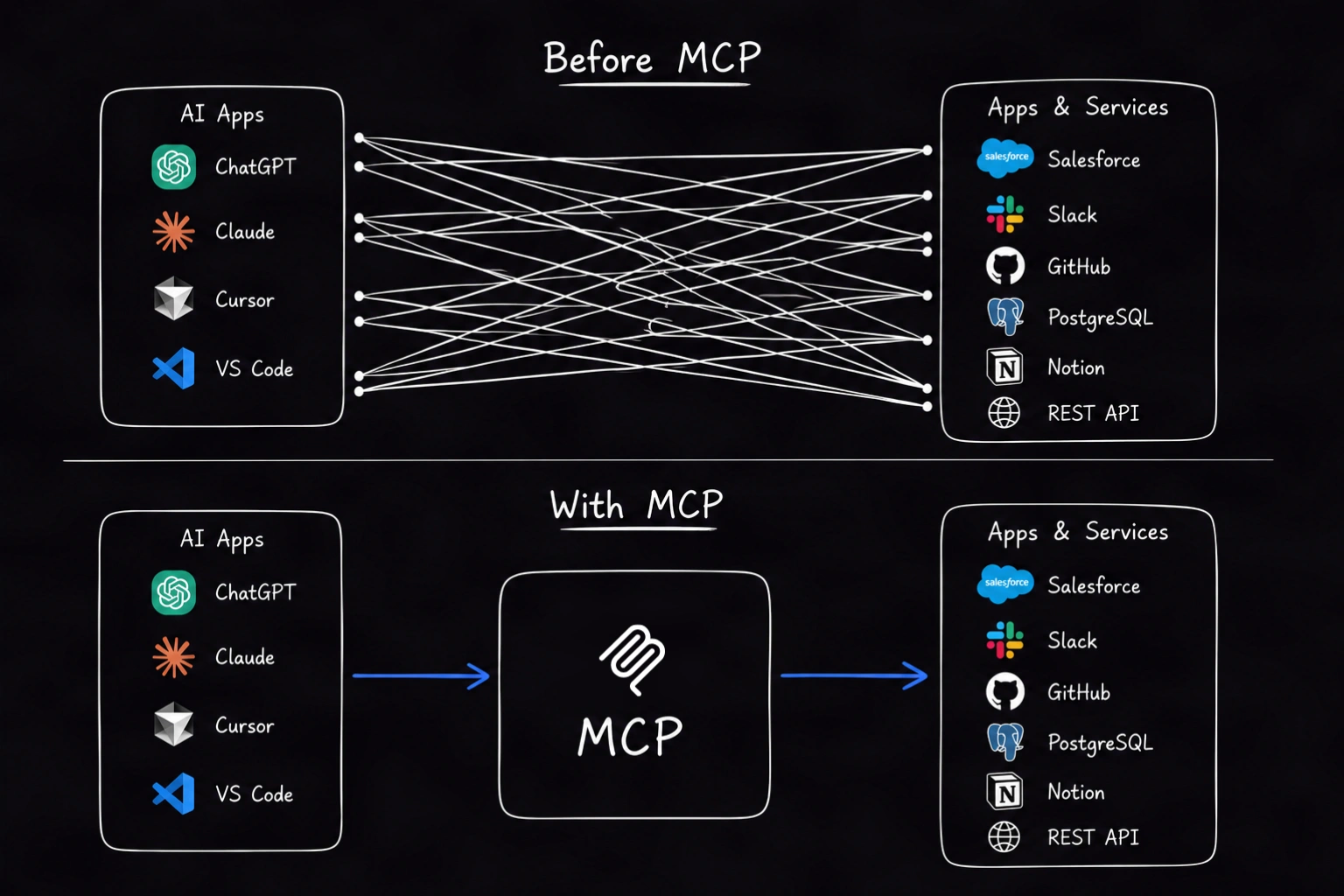
MCP reduces integration fragmentation
AI applications become more useful when they can work with current information and real systems. They may need to read a file, search a database, inspect an account, or call an API. Custom integrations make this possible, but they create repeated work. Every integration may need its own connection logic, capability definitions, authentication flow, error handling, and maintenance plan. MCP standardizes the interface between compatible AI applications and external systems. A server can describe its capabilities once. Compatible clients can then discover and use those capabilities through the same protocol. This does not eliminate all integration work. You still need to design safe tools, configure authentication, and maintain the underlying system. It does reduce the amount of client-specific plumbing.Why MCP matters for AI builders
MCP gives AI builders a reusable integration layer. Instead of writing a different connector for each application, you can connect to MCP servers that expose well-defined tools, resources, and prompts. This helps builders:- Add capabilities without embedding every integration in the application
- Separate AI orchestration from business logic
- Reuse servers across compatible clients
- Test protocol behavior independently from the model
- Add or remove integrations without redesigning the entire application
Why MCP matters for API providers
APIs were designed primarily for developers writing deterministic software. AI applications are different consumers. They need clear capability descriptions, structured inputs, predictable outputs, and enough context to choose the right operation. An MCP server gives an API provider an AI-facing interface. Selected API operations can become tools that compatible AI clients can discover and call. For an API-first company, this creates another distribution channel:Why MCP matters for product teams
MCP lets product teams add useful AI capabilities without coupling every workflow to one model vendor or client. A support product might expose tools for retrieving a customer, creating a ticket, and updating a case. A project platform might expose tasks, comments, and status changes. A commerce platform might expose products, orders, and refunds. Clear protocol boundaries make these capabilities easier to govern. Teams can decide:- Which operations an AI application may discover
- Which actions require user approval
- Which credentials and scopes are required
- What information a tool returns
- How calls are logged and monitored
Why MCP matters for users
MCP can make AI applications more relevant to a user’s actual work. With approved connections, an assistant can use current information instead of relying only on model training or pasted context. It can also request actions in connected systems. Examples include:- Finding the status of an order
- Reading a project document
- Creating a support ticket
- Checking a calendar
- Updating a CRM record